



Read Blog Post
Crisis SMM 2026: Action Plan for Negative Reviews, Scandals & Account Bans

24.08.2026
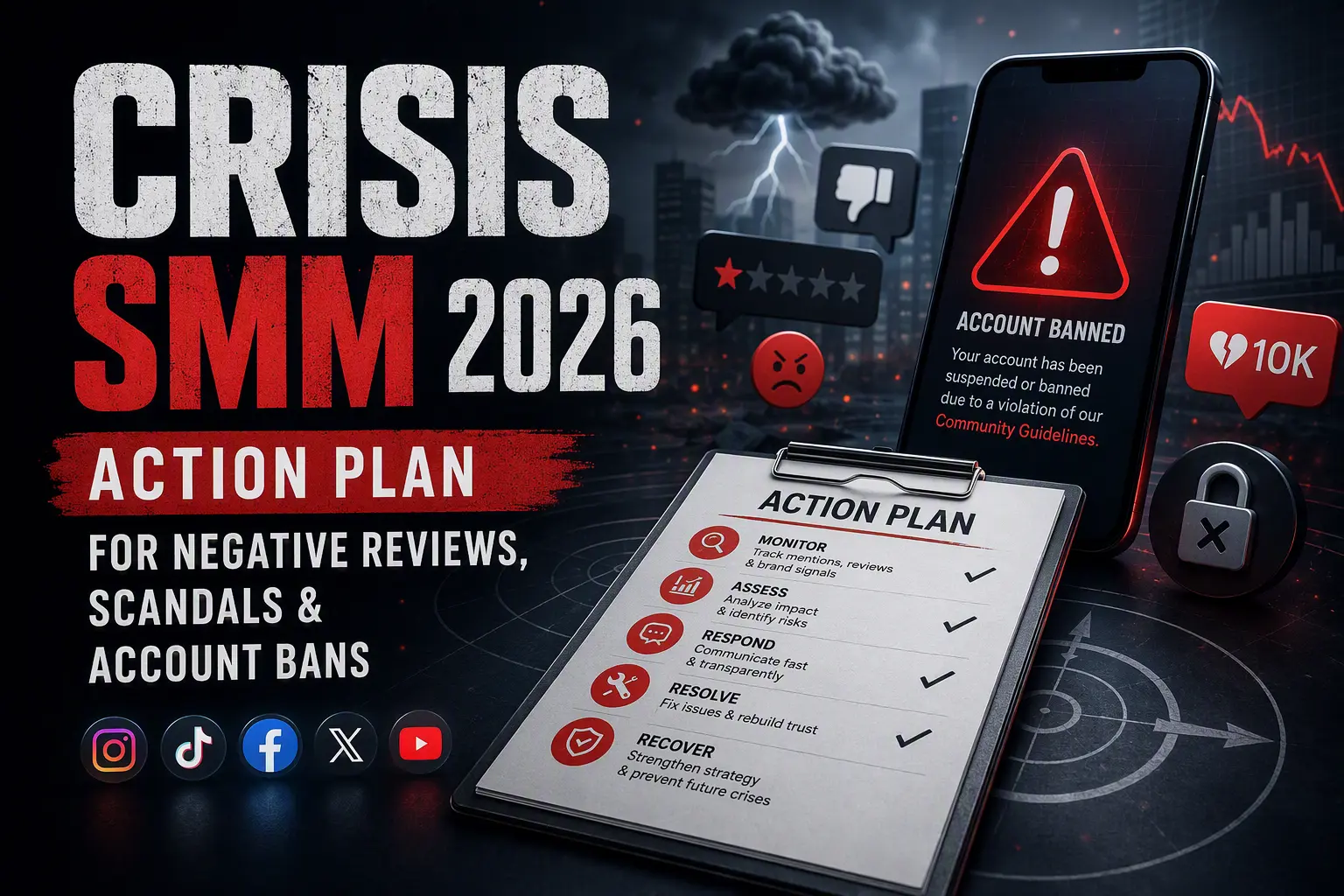
Let me be honest with you: if you're active on social media, a crisis is not a matter of if – it's a matter of when. A bad review goes viral. A customer complaint spirals into a Twitter storm. An algorithm update wipes out your reach. Or worse – your account gets banned or suspended.
I've been through two major social media crises with brands I worked with. The first one was a disaster – we panicked, responded poorly, and lost 15% of our followers in a week. The second one? We had a plan. We followed it step by step. And we came out of it with more trust and engagement than before.
In this article, I'll share the exact crisis management framework I now use with every client. Whether you're dealing with a single negative comment or a full‑blown reputation meltdown, these steps will help you respond, recover, and rebuild.
Step 1: Prepare Before the Crisis Hits
This is the most important step – and the one most brands skip. You can't build a crisis plan in the middle of a crisis. You need to prepare in advance. Here's what I recommend:
- Create a crisis response team. Assign roles: who monitors comments, who drafts responses, who approves them, who communicates with leadership.
- Draft response templates. Have pre‑written responses for common scenarios: product complaints, delivery issues, customer service failures.
- Set up monitoring. Use tools like Brand24, Mention, or even simple Google Alerts to track brand mentions in real time.
- Define escalation levels. A single negative comment is Level 1. A viral controversy is Level 5. Know when to escalate.
Preparation takes a few hours – but it can save you weeks of damage control later.
Step 2: Identify the Crisis (and Its Severity)
When something happens, your first instinct might be to panic. Don't. Take a breath and assess the situation. Ask yourself:
- How widespread is this? Is it one comment, or is it spreading across platforms?
- Is it valid? Is the complaint legitimate, or is it a troll?
- What's the sentiment? Are people angry, disappointed, or just confused?
- What's the potential impact? Will this affect sales, reputation, or just a few followers?
Not every negative comment needs a full crisis response. Sometimes a simple, private apology is enough. But if you see the same complaint repeated, or if it's gaining traction, it's time to act.
Step 3: Respond Quickly and Transparently
Speed matters. In 2026, social media moves faster than ever. A late response is often worse than no response – it signals that you don't care.
Here's my golden rule: respond within 60 minutes of detecting a crisis. You don't need to have a perfect answer yet. You just need to acknowledge the issue and let people know you're working on it.
Example response template:
"We hear you. We're looking into this right now and will update you within [timeframe]. We take this seriously."
Notice what this does: it validates the person's concern, shows action, and buys you time to investigate properly. Never defend or deflect in your first response – just acknowledge and commit to follow‑up.
Step 4: Investigate and Gather Facts
Once you've acknowledged the issue, it's time to get the full picture. Talk to your team, check your records, and verify the facts. Here's what you need to know:
- What actually happened? Get the factual timeline.
- Who was affected? Was it one customer or many?
- Was it our fault? Be honest. If it was, own it.
- What's the solution? Can you fix it immediately? If not, what's the timeline?
This investigation should take no more than 2‑3 hours. Don't drag it out – uncertainty fuels speculation and anger.
Step 5: Communicate the Resolution
Once you have the facts and a solution, communicate it publicly and privately. For public communication:
- Post an update on your main social channels.
- Be specific – don't be vague. Say exactly what happened and what you're doing about it.
- Show empathy – apologize sincerely if you were at fault.
- Highlight the fix – show that you've learned and improved.
Example:
"We made a mistake with [issue]. We've fixed it, and we're refunding all affected customers. We've also added a new review process to prevent this from happening again. We're sorry – and we'll do better."
For private communication (affected customers or individuals), reach out directly via DM or email. A personal apology goes a long way in rebuilding trust.
Step 6: Amplify Positive Signals to Rebuild Trust
After a crisis, your reputation takes a hit. Even if you handled it perfectly, there will be lingering negativity. That's where social proof comes in. You need to show that the majority of your customers still trust you.
Here's what I do:
- Share positive testimonials and reviews – especially from recent customers.
- Post user‑generated content – happy customers using your product.
- Use paid social signals – a small boost of positive Instagram comments or YouTube likes can help drown out the negativity. But remember: quality matters. Low‑quality bots will make things worse. Use trusted providers that deliver real‑looking engagement.
In one of my crisis recoveries, we increased positive UGC by 40% in two weeks using this approach. The algorithm started showing our positive posts again, and the crisis faded from public view.
Step 7: Recover From Account Bans or Suspensions
This is every SMM manager's nightmare: you wake up to find your account banned or restricted. First, don't panic. Here's a systematic recovery plan:
- Check the reason. Most platforms (Instagram, TikTok, YouTube) will tell you why you were banned. Read the notification carefully.
- Appeal immediately. Use the official appeal process. Be polite, professional, and provide any requested documentation.
- Stop any paid activity. If you're using automation or SMM panels, pause everything until your appeal is resolved.
- Clean up your account. Remove any content that might violate terms. Delete suspicious followers if you can.
- Wait patiently. Appeals can take days or even weeks. Don't spam the support team – it slows things down.
- Have a backup plan. If your main account is banned, you should already have a secondary account or alternative platform ready to go.
Pro tip: if you use SMM panels, choose providers that are platform‑compliant. Low‑quality services that use bots or spam techniques increase your risk of bans. In our guide to choosing SMM panels, we explain exactly what to look for.
Step 8: Learn and Adapt for the Future
Every crisis is a lesson. After the dust settles, do a post‑mortem:
- What triggered the crisis? (Was it a product issue, a customer service failure, or something else?)
- How did we respond? What worked well? What could we have done better?
- What changes should we make? Update your processes, templates, or team structure to prevent recurrence.
Document everything. Next time, you'll have a stronger plan – and you might even prevent the crisis from happening in the first place.
When a Crisis Is Actually an Opportunity
Here's a counter‑intuitive thought: a well‑handled crisis can strengthen your brand. Why? Because it shows transparency, accountability, and a commitment to customers. Many brands have actually grown their following after a crisis because people appreciated their honesty.
Think about it: when a brand admits a mistake and fixes it publicly, that's powerful. It humanizes you. It builds trust. So while a crisis is never fun, it's not the end of the world – it's a chance to prove your integrity.
Related Reading from Our Blog
These articles will complement your crisis management strategy and help you build a resilient brand presence:
- Psychology of Engagement: Create Posts People Comment, Save & Share – understand how audiences react emotionally to brand messages.
- User-Generated Content as a Growth Engine – use positive UGC to counter negativity after a crisis.
- Safe Strategies to Buy Followers – avoid practices that could trigger platform bans.
- How to Choose the Best SMM Panel for Instagram – essential for selecting crisis‑safe providers.
- SMM Analytics 2.0: Which Metrics Really Drive Profit – track reputation metrics after a crisis.
Frequently Asked Questions (FAQ)
Here are the most common questions we get about handling social media crises in 2026.
1. What's the most important rule in crisis communication?
Acknowledge quickly, even if you don't have a full solution yet. A prompt response shows you care and buys you time to investigate properly. Silence is the worst strategy.
2. Should I delete negative comments during a crisis?
Generally, no – unless they violate your community guidelines (hate speech, spam, etc.). Deleting legitimate criticism makes you look dishonest and fuels further outrage. Respond to them instead.
3. How do I respond to a false accusation or troll?
If it's clearly a troll, ignore it. If it's a false accusation gaining traction, respond once with facts and evidence. Then let your positive community speak for you. Don't engage in a back‑and‑forth argument.
4. Can buying followers or likes cause an account ban?
Yes – if you use low‑quality services that rely on bots or spam techniques. High‑quality, compliant providers minimize this risk. Always read our guide on safe strategies before purchasing.
5. How long does a social media crisis usually last?
Most crises peak within 24‑72 hours and fade within a week – if handled properly. If ignored, they can linger for months. Quick, transparent responses shorten the crisis window significantly.
6. What if my account is permanently banned?
If all appeals fail, start building a new account immediately. Use your other channels (email list, other social platforms) to redirect your audience. And always keep a backup account for emergencies.
7. How can I measure if my crisis response was effective?
Track three things: (1) sentiment change (positive vs negative mentions), (2) engagement rate recovery, and (3) conversion rate (sales or sign‑ups) compared to pre‑crisis levels. Improvement across all three signals successful recovery.
Start Using the SMM Services Now!
Cheapest Followers, Likes, Views, Reactions for Social Media
Sign Up Now