



Read Blog Post
Psychology of Engagement: How to Create Posts People Comment, Save and Share in 2026

23.08.2026
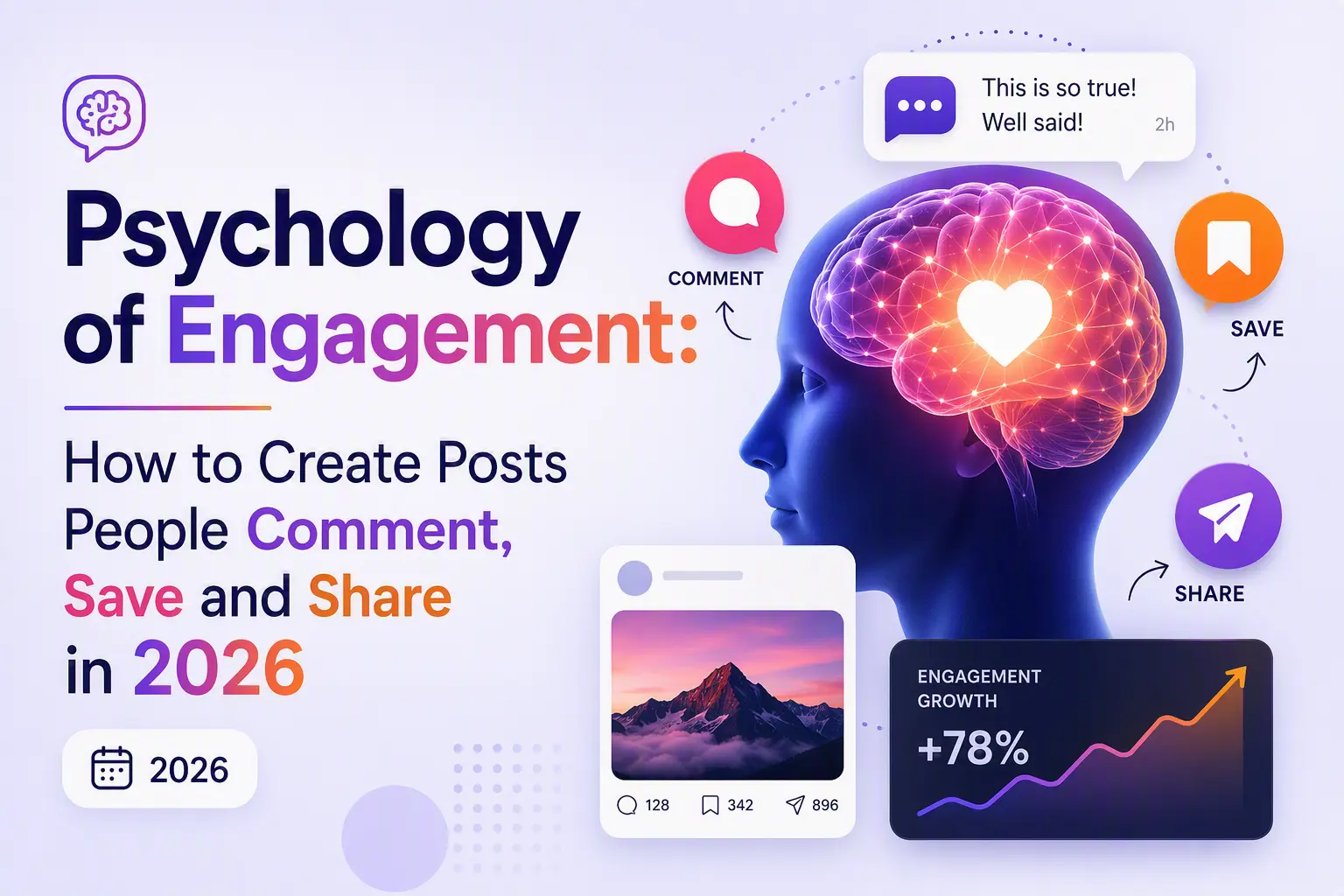
Here's a hard truth I've learned after years in SMM: you can have the best product, the most beautiful visuals, and a solid budget for paid promotion – but if your posts don't trigger an emotional response, nobody will engage. Comments, saves, shares – these don't happen by accident. They happen because you've pressed the right psychological buttons.
I've analyzed hundreds of high-performing posts across Instagram, TikTok, and LinkedIn. And the pattern is clear: viral content follows predictable psychological principles. The good news? You can learn them. Let me show you what actually works in 2026.
1. The Emotion First Rule
Facts don't drive engagement. Emotions do. Jonah Berger, a Wharton marketing professor, studied why things catch on and found that emotion is one of the six key mechanisms behind virality. When people feel something – surprise, anger, awe, or even fear – they're far more likely to comment or share.
What this means for you: start your post with an emotion-packed statement, not a fact. Instead of "We launched a new feature," try "We almost gave up on this feature. Here's why we didn't." One is informative. The other is human.
Practical tip: before you publish anything, ask yourself: "What emotion will this post trigger?" If the answer is "none" or "I'm not sure," rewrite it. Emotion is the engine of engagement – without it, your post is just noise.
2. Social Proof: Show That Others Are Already Engaged
Humans are herd animals. We look to others to figure out what's worth paying attention to. That's social proof in action. When people see that a post already has comments and saves, they're more likely to add their own.
How to use this:
- Reply to the first few comments quickly – it signals that the conversation is alive.
- Pin a thoughtful comment to the top of your post.
- If you're using paid social signals to give your post an initial boost, that's fine – but remember that quality engagement matters more than quantity. A hundred real comments are worth more than a thousand bot likes.
One more thing: research shows that posts with images of people, animals, or objects in motion get more engagement. Motion = life = social proof that something interesting is happening.
3. Curiosity Loops: The Hook That Keeps Them Reading
You've seen this a thousand times: a post that starts with "I almost didn't post this..." or "The one thing nobody tells you about..." That's a curiosity loop. It opens a gap between what the reader knows and what they want to know. And humans hate leaving gaps unfilled.
The anatomy of a curiosity loop:
- Hook – the first 3-6 seconds (or the first line of text) that grabs attention.
- Delay – you don't reveal the answer immediately. You build tension.
- Payoff – you deliver value, but leave room for more.
Here's a concrete example: instead of "Here are 5 tips for better engagement," try "I tested 47 strategies for engagement. Only 5 worked. Here's what I learned." See the difference? The second version creates curiosity. The reader needs to know which 5 worked.
Pro tip: curiosity loops work especially well in short-form video. The first 3 seconds determine whether someone scrolls past or stays. Use text overlays, unexpected visuals, or a provocative spoken line to hook them immediately.
4. Practical Value: Give Them Something They Can Use
People share content that makes them look good, smart, or helpful. That's why "how-to" posts, checklists, and templates perform so well. When you give someone a practical takeaway, they're likely to save it for later – and share it with others who might benefit.
What works in 2026:
- Step‑by‑step guides with numbered lists.
- Before/after comparisons.
- Free templates or swipe files.
- Mistakes to avoid (nobody wants to repeat your errors).
And here's a pro tip: saves (bookmarks) are gold. Platforms like Instagram and Threads now prioritize saves in their algorithms because they signal high-value content. A post with 100 saves will often outrank a post with 500 likes but zero saves. So design your content to be useful, not just entertaining.
5. The Power of Stories and Authenticity
People don't connect with brands. They connect with people. And they connect through stories – testimonials, personal journeys, conflicts, and unexpected twists.
Here's what the data says: self‑deprecating humor and authenticity drive the highest engagement rates. When you admit a mistake, share a failure, or show vulnerability, you signal that you're real. And in a world full of polished, filtered content, real stands out.
Practical examples:
- Share a behind‑the‑scenes moment that didn't go perfectly.
- Tell a story about a customer who struggled and succeeded.
- Admit something you used to believe that turned out to be wrong.
This doesn't mean you should overshare or be unprofessional. It means you should be human. Authenticity isn't about being messy – it's about being honest.
6. Visual Triggers: Colors, Motion, and Contrast
What your post looks like matters just as much as what it says. Research shows that warm colors (reds, oranges, yellows) increase engagement and sharing. Bright, high‑contrast visuals stop the scroll. And motion – even subtle movement – captures attention more effectively than static images.
Simple visual rules for 2026:
- Use warm, vibrant colors – not dark or muted tones.
- Include movement where possible (short video clips or GIFs).
- Keep it simple – one clear focal point works better than clutter.
If you're posting a static image, ask yourself: "Would this make me stop scrolling?" If the answer is no, go back to the drawing board.
7. The Comment Trigger: Ask the Right Questions
Comments are the lifeblood of engagement. But "What do you think?" is a lazy question that rarely gets responses. You need to ask something that people want to answer.
High‑performing question formats:
- Opinion questions: "What's the one thing you'd change about [industry]?"
- Personal experience: "Have you ever [situation]? Tell me your story."
- Controversial (but safe): "Unpopular opinion: [statement]. Agree or disagree?"
- Fill‑in‑the‑blank: "The biggest mistake I made was ____. What's yours?"
And here's a simple rule: reply to every comment in the first hour after posting. It creates a feedback loop – people see you're active and responsive, so they're more likely to join the conversation. This also signals to the algorithm that your post is generating real engagement, which can boost your reach organically.
When Paid Social Signals Fit Into This Strategy
Let's be real: even the most psychologically perfect post can get lost in the feed. That's where paid social signals – followers, likes, views – can give you a temporary lift. Think of it as priming the pump: a small boost can trigger the social proof effect I mentioned earlier, making your post look more popular than it would organically.
But here's the catch: if your content doesn't have the psychological hooks we've discussed, even paid signals won't save it. Engagement signals from real users (comments, saves, shares) are what drive long‑term growth. Paid services are a catalyst, not a replacement for good content.
If you're looking for reliable services to give your posts that initial push, you can explore Instagram engagement services or YouTube growth packages on our platform. Just remember: use them to amplify great content, not to replace it.
Related Reading from Our Blog
These articles from our blog cover complementary topics that will help you build a complete engagement strategy:
- How the Instagram Algorithm Works in 2026 – understand what the algorithm actually rewards (hint: it's engagement).
- Safe Strategies to Buy Followers – avoid common pitfalls when using paid signals.
- Instagram Saves vs Likes: Algorithm Guide 2026 – why saves matter more than ever.
- TikTok Growth Hacks 2026 – short‑form strategies that pair perfectly with psychological triggers.
- Optimize Social Media Profiles in 2026 – first impressions matter for engagement too.
Frequently Asked Questions (FAQ)
Here are the most common questions we hear about driving engagement – with answers based on real data and experience.
1. What's the single most important factor for engagement in 2026?
Emotion. Posts that make people feel something – surprise, curiosity, anger, or joy – consistently outperform neutral, informative content. Start with emotion, then add value.
2. How many comments should I aim for per post?
Quality over quantity. A post with 20 genuine, thoughtful comments is worth more than a post with 200 "nice post" comments. Focus on sparking real conversations, not just collecting numbers.
3. Do saves really matter for the algorithm?
Yes. Platforms like Instagram and Threads now prioritize saves because they signal that users found the content valuable enough to return to. A post with high saves often gets more organic reach than one with high likes but low saves.
4. Is it better to post more often or post better content?
Better content wins every time. One high‑quality post that triggers emotion and conversation is worth 10 mediocre posts. Focus on quality, then scale frequency once you have a proven formula.
5. Can buying likes or views help my engagement?
It can give you a temporary social proof boost, but it won't drive real comments or saves. Use paid signals as a catalyst for great content, not as a replacement. Low‑quality bots can actually hurt your engagement rate.
6. How long should my captions be for maximum engagement?
There's no magic number, but longer captions (150‑300 words) often perform better because they give you room to tell a story and build curiosity. Just make sure every sentence serves a purpose – don't add fluff.
7. How do I get people to share my posts?
People share content that makes them look good, helps others, or triggers strong emotion. Give them practical value (checklists, templates), tell relatable stories, or create content that's funny or surprising. And always include a clear call‑to‑action: "Tag someone who needs to see this."
Start Using the SMM Services Now!
Cheapest Followers, Likes, Views, Reactions for Social Media
Sign Up Now