



Read Blog Post
SMM Analytics 2.0: Which Metrics Really Drive Profit in 2026

24.08.2026
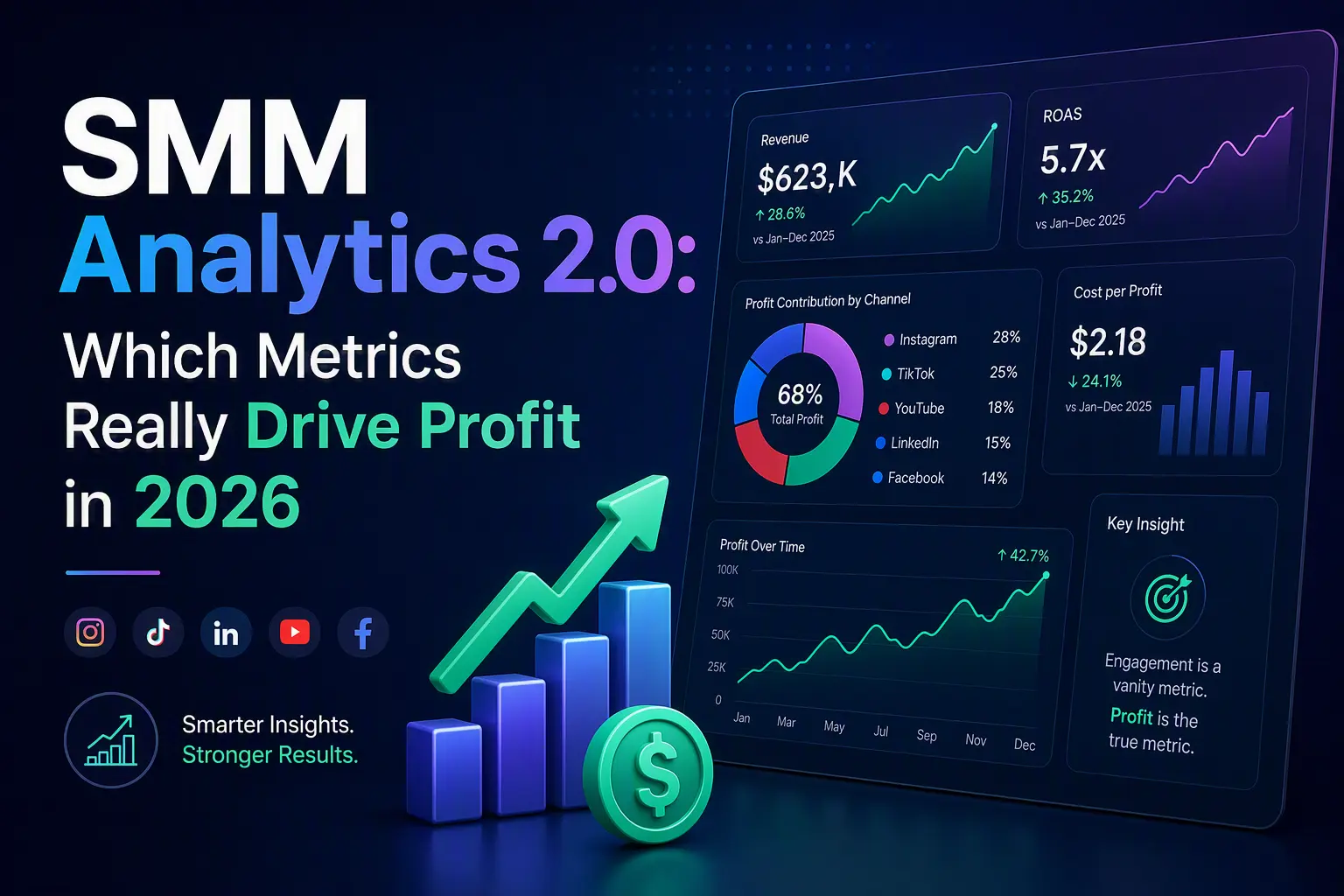
Let me tell you something that took me years to learn: most SMM reports are useless. Not because they're wrong – but because they measure the wrong things. Follower count, likes, even engagement rate – these are vanity metrics. They make you feel good, but they don't tell you if your social media strategy is actually making money.
In 2026, the game has changed. Platforms are more complex, ad costs are higher, and competition is fiercer. You can't afford to guess. You need to know exactly which posts, which platforms, and which tactics drive real business outcomes – not just clicks and views.
I've spent the last two years helping brands overhaul their analytics dashboards. Here's what actually matters – and what you can safely ignore.
The Vanity Metrics Trap: What Not to Waste Time On
Let's start with the enemy. These are the metrics that look impressive in a presentation but have zero correlation with revenue:
- Follower count – a big number looks nice, but if those followers don't engage or buy, they're worthless. I've seen accounts with 50k followers generate less revenue than accounts with 5k.
- Impressions – seeing your post isn't the same as acting on it. Impressions are cheap; actions are valuable.
- Likes – the easiest, laziest form of engagement. They don't signal intent or interest in your product.
- Reach – again, it's a top‑of‑funnel number. It doesn't tell you if anyone actually cared.
Now, I'm not saying these metrics are completely useless. They can give you a rough sense of awareness. But if you're optimizing for them, you're optimizing for the wrong goal. The real question is: what metrics actually predict revenue?
The Profit‑Driving Metrics You Should Track in 2026
Here's my shortlist of KPIs that matter. These are the numbers that, when they go up, your revenue goes up with them.
1. Customer Acquisition Cost (CAC)
How much does it cost you to acquire one paying customer through social media? This includes ad spend, content production, and tool costs. If your CAC is higher than your customer lifetime value, you're losing money on every sale.
What to do: Track CAC per channel (Instagram, TikTok, Threads, etc.) and per campaign type (organic vs paid). You'll quickly see which channels are profitable and which are draining your budget.
2. Customer Lifetime Value (LTV)
How much revenue does an average customer generate over their entire relationship with you? If your LTV is high, you can afford a higher CAC. But if your LTV is low, you need to tighten your acquisition spend.
What to do: Use analytics tools (like Triple Whale or Hyros) to connect social engagement data with purchase history. You'll see which posts bring in high‑LTV customers – not just one‑time buyers.
3. Return on Marketing Investment (ROMI)
This is the granddaddy of them all: revenue generated per dollar spent on social marketing. ROMI tells you if your entire SMM strategy is profitable.
What to do: Calculate ROMI for each platform and each campaign. If a channel has ROMI below 1, you're burning money. If it's above 3, double down.
4. Conversion Rate (Social to Sale)
Not just clicks – but actual purchases. How many people who see your post or ad actually buy? This metric cuts through the noise and tells you if your content is persuasive enough to close deals.
What to do: Set up proper tracking (UTM parameters, pixel, or server‑side tracking). Without it, you're flying blind.
5. Save Rate (Bookmarks)
Why saves? Because they signal high‑value intent. When someone saves a post, they're saying: "This is useful. I want to come back to it." Platforms like Instagram and TikTok now prioritize saves in their algorithms because they correlate with long‑term engagement and eventual purchases.
What to do: Track saves per post and look for patterns. Which topics get saved most? Those are the ones you should create more of.
How to Set Up Analytics That Actually Work
You can't track what you don't measure. Here's a practical setup that works for most brands in 2026:
- Google Analytics 4 (GA4) – the baseline. Set up conversion goals (purchases, sign‑ups, downloads) and link them to your social channels using UTM tags.
- Native platform insights – Instagram, TikTok, and YouTube all offer decent analytics. Use them for granular content performance (saves, shares, watch time).
- A third‑party dashboard – tools like Databox, Sprout Social, or Hootsuite can consolidate data from multiple sources. This is a lifesaver if you're managing more than two platforms.
- Attribution software – if you're running paid ads, invest in something like Triple Whale or Hyros. They track the full customer journey and show you exactly which touchpoints drive conversions.
Once your tracking is in place, review your dashboards weekly (not daily – daily data is too noisy). Look for trends over time, not individual spikes.
Using Analytics to Optimize Paid Social Signals
Here's where analytics gets really powerful: it helps you decide when and where to use paid services (followers, likes, views). Instead of guessing, you can use data to target your spend.
For example, let's say your analytics show that posts with a save rate above 5% generate 3x more conversions than posts with lower saves. You can identify your best‑performing organic posts and give them a small boost with Instagram engagement services or YouTube views to amplify their reach. The boost triggers social proof, which leads to more organic saves, which leads to more conversions.
But here's the crucial part: only amplify content that already performs well organically. Don't waste money boosting a post with a 1% save rate – no amount of paid views will fix bad content. Use analytics to pick winners, then use paid signals to multiply their success.
You can learn more about choosing the right providers in our guide on how to choose the best SMM panel – the same principles apply to analytics‑driven decision making.
Common Analytics Mistakes (And How to Avoid Them)
Even smart marketers mess this up. Here are the three most frequent errors I've seen:
- Mistake #1: Looking at isolated metrics. A post with 100k views but 0 conversions is a failure. Always view metrics in context – what happened after the view?
- Mistake #2: Ignoring attribution windows. A customer might see your post today, but buy three days later. If you only track same‑day conversions, you'll undercount your results. Set a 7‑day or 30‑day attribution window.
- Mistake #3: Not segmenting by audience. Your organic followers and paid audience are different. Track them separately. What works for one group may fail for the other.
Fix these, and your analytics will instantly become more useful.
The Future of SMM Analytics (What's Coming in 2026–2027)
AI is already transforming analytics. Predictive tools can now tell you which posts will perform best before you publish. Sentiment analysis monitors comments in real time. And unified dashboards are finally connecting social data with CRM and sales data.
In the next 12 months, I expect three big shifts:
- Predictive analytics – AI will recommend content topics based on historical conversion data.
- Cross‑platform attribution – tracking a user from Instagram to website to purchase, even without cookies.
- Automated optimization – systems that automatically boost high‑performing posts with paid signals based on real‑time conversion data.
Brands that adopt these tools early will have a significant advantage. But even without bleeding‑edge tech, the fundamentals I've outlined here will give you a huge edge over competitors still chasing likes.
My Honest Take: Stop Reporting Vanity, Start Reporting Value
If you walk away with one thing from this article, let it be this: social media is an investment, not an expense. And every investment should have a measurable return. If you can't tie your social activity to revenue, you're not doing SMM – you're gambling.
Start by cutting two vanity metrics from your next report. Replace them with one profit metric (like CAC or ROMI). Then build from there. Your CEO, your clients, and your bottom line will thank you.
Related Reading from Our Blog
These articles will deepen your understanding of analytics, engagement, and how to use data to drive growth:
- How the Instagram Algorithm Works in 2026 – understanding the algorithm helps you interpret your analytics.
- Psychology of Engagement: Create Posts People Comment, Save & Share – because the best analytics start with great content.
- User-Generated Content as a Growth Engine – see how UGC drives conversion metrics.
- How to Grow a YouTube Channel in 2026 – includes practical analytics tips for video content.
- How to Choose the Best SMM Panel for Instagram – use analytics to choose the right provider.
Frequently Asked Questions (FAQ)
Here are the most common analytics questions we hear from brands and creators in 2026.
1. What's the most important metric for SMM in 2026?
Return on Marketing Investment (ROMI). It tells you if your social spend is actually profitable. Without ROMI, you're operating in the dark.
2. How do I track conversions from social media if I'm not using ads?
Use UTM parameters on all your links. Then check your analytics platform (Google Analytics, etc.) to see which social channels and posts drive the most conversions. You can also use link‑in‑bio tools with built‑in tracking.
3. Should I track engagement rate or save rate?
Both, but prioritize saves. Engagement rate (likes + comments / followers) is an awareness metric. Saves indicate genuine interest and correlate more strongly with purchases. Track saves per post and optimize for them.
4. How often should I review my analytics?
Weekly for content performance (which posts are winning), monthly for strategic metrics (CAC, LTV, ROMI), and quarterly for overall channel health. Don't check daily – it leads to overreaction.
5. Can buying followers or likes distort my analytics?
Yes, if you buy low‑quality bots. They increase your follower count but don't engage, which lowers your engagement rate and skews data. If you buy signals, use high‑quality services that deliver real‑looking accounts. And always track organic vs paid separately.
6. What's a good Customer Acquisition Cost (CAC) for social media?
It depends on your industry. For e‑commerce, a CAC of $20‑$50 is common. For SaaS, it can be $200‑$500. The key is to compare it to your Customer Lifetime Value (LTV) – your CAC should be significantly lower than your LTV.
7. What's the biggest analytics mistake brands make in 2026?
Focusing on platform‑specific metrics (likes, views) instead of business metrics (revenue, conversions). They report vanity numbers to stakeholders without showing actual ROI. Always translate social metrics into business outcomes.
Start Using the SMM Services Now!
Cheapest Followers, Likes, Views, Reactions for Social Media
Sign Up Now