



Read Blog Post
Telegram Channel vs Group: Where to Buy Growth in 2026

29.07.2026
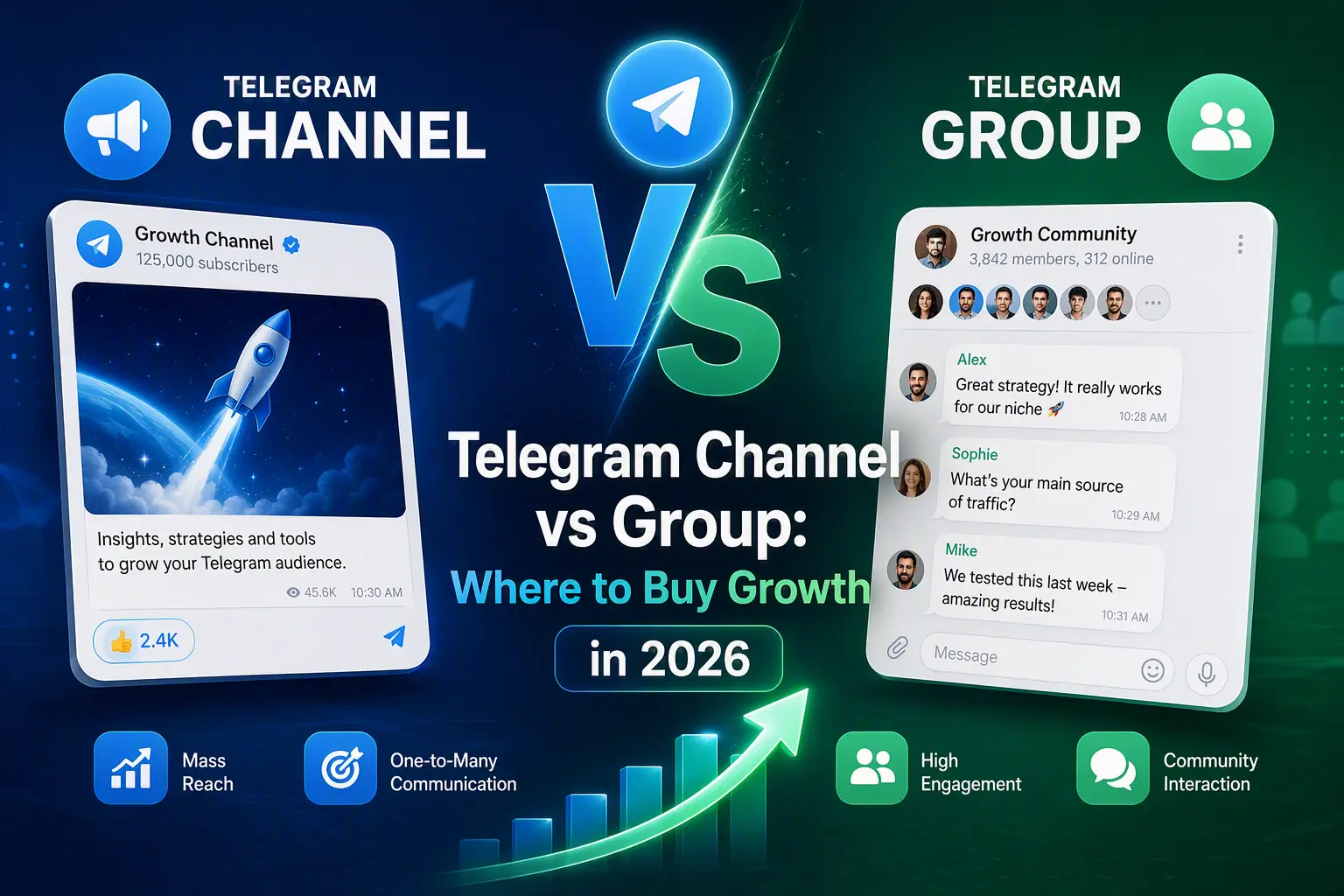
If you are starting a Telegram community in 2026, the first decision you make — channel or group — quietly sets the ceiling on how fast you can grow, what kind of engagement you will see, and what kind of growth services actually move the needle. Buy the wrong format and even the best SMM panel order will look like wallpaper; buy the right one and the same budget can deliver 3–5× more reach.
There are real, measurable differences between Telegram channels and groups in 2026: member caps, view-to-member ratios, retention benchmarks, and the kinds of paid services that even make sense. This guide walks through the data, the use cases, and the buying decisions, with pricing sourced from public 2025–2026 SMM panel listings and Telegram's own documentation. Whether you are a creator with 500 followers or an agency managing 50 communities, the framework below will help you spend smarter.
Quick Answer: Which One Should You Pick in 2026?
- Pick a Telegram channel if your goal is one-to-many broadcasting: news, content drops, announcements, education, deals, crypto signals, podcasts. Channels scale to unlimited subscribers, surface in Telegram search, and have measurable per-post view rates.
- Pick a Telegram group if your goal is many-to-many conversation: support, niche community, fan discussion, mastermind, paid VIP circle. Groups cap at 200,000 members and show much higher active view-to-member ratios (often 50–70%) but offer no broadcast-style metrics.
- Run both if you want a content channel for reach plus a discussion group for community. This is the dominant 2026 pattern for creators and brands past 10k subscribers.
Need numbers? Below is the full comparison, plus a buying guide that maps each service type (members, reactions, post views, auto-views) to the format where it actually works.
Telegram Channel vs Group: The 2026 Feature Comparison
| Feature | Channel | Group |
|---|---|---|
| Primary use | One-to-many broadcast | Many-to-many discussion |
| Member limit | Unlimited | 200,000 (public & private) |
| Public discovery (search) | Yes, indexed by Telegram search | Public groups yes, private only by invite link |
| Username / @handle | Yes, required for public | Yes, optional |
| Post signatures | Signed by channel name | Signed by user who posts |
| Per-post view metric | Yes (visible to admins) | Per-message views visible, but not aggregated |
| Reactions on content | Yes (since 2022) | Yes (since 2022) |
| Comments under posts | Via linked discussion group | Native (in-line) |
| Slow-mode / anti-spam | No (only admins post) | Yes, configurable |
| Pin / silent messages | Yes | Yes |
| Analytics (native) | Full (subscribers, reach, views, ER, growth graph) | Basic (members, recent messages) |
| Third-party analytics (TGStat, Telemetr) | Yes, deep coverage | Limited |
Source: Telegram Channels documentation; Telegram Groups documentation; TGStat & Telemetr public dashboards (retrieved 2026-07-29).
Member Caps and Why They Matter for Growth
The single biggest structural difference in 2026 is the member cap. Telegram removed historical caps on public and private channels, so a broadcast channel can host an audience of any size. Public and private groups, including supergroups, are still capped at 200,000 members. The cap has not changed in the 2024–2026 update cycle.
What this means in practice:
- If your community goal is past 200k, you must run a channel. Most large media brands, crypto projects, and creators with audiences in the 500k–5M range operate channels as their primary surface.
- If your community is a paid VIP or mastermind under 200 members, a private group is almost always the right format. The conversation dynamics, slow-mode, and per-user identity all match the use case.
- For audiences between 10k and 200k, the choice is about engagement style, not size. See the next section.
For broadcast-style communities, see our guide on 12 Telegram tips that grow your channel in 2026 for a deeper dive into channel-specific tactics.
Engagement Benchmarks: Channel vs Group in 2026
Engagement behaviour differs sharply by format. In a 2024–2025 analysis of more than 1.1 million posts across 22,000+ channels, TGStat found that the median view-to-subscriber ratio on public channels is 20–40%, with strong variance by niche. News and finance channels sit at the high end (35–45% median); entertainment and meme channels sit lower (15–25%).
Groups behave differently. Because members actively open the chat, view-to-member ratios in active groups are typically 50–70% — but this number is harder to track because Telegram's native group analytics surface only a basic recent-messages count, not a per-day reach graph. Telemetr and TGStat both publish group ER benchmarks, but the data is thinner than for channels.
| Metric | Channel (median, 2024–2025) | Group (typical, 2024–2025) |
|---|---|---|
| View-to-member ratio | 20–40% | 50–70% |
| Reactions per post (top quartile) | 0.5–1.5% of subs | 2–5% of members |
| Forward rate | 1–3% of views | 0.5–1% of views |
| Comments per post (if discussion group) | 0.1–0.5% of subs | 5–15% of members |
| 30-day retention (paid services) | 40–60% | 50–70% |
Source: TGStat Benchmarks 2024–2025 (1.1M posts, 22k channels); Telemetr group analytics samples; allsmm.net customer data (retrieved 2026-07-29).
The practical takeaway: if your goal is raw reach, channels win. If your goal is active community, groups win. The buying decisions below reflect that split.
Decision Framework: Pick by Use Case
Use the table below to map your goal to the right format. If you are running both, treat the channel as the growth engine and the group as the retention engine.
| Use case | Best format | Why |
|---|---|---|
| News / media outlet | Channel | Broadcast model, high view rates, no per-user identity needed |
| Crypto / trading signals | Channel + paid group | Channel for reach, private group for VIP signal chat |
| Education / course | Channel (with discussion group) | Lessons broadcast daily, students discuss in group |
| Creator fan community | Channel + open group | Channel for drops, group for fan interaction |
| Customer support | Group (private) | Two-way conversation, ticket-style replies |
| Local community / city | Group (public) | Members know each other, conversation-first |
| Deals / coupons niche | Channel | One-to-many, high forward rate, low comment need |
| Mastermind / paid VIP | Group (private, paid) | Small audience, identity matters, slow-mode helps |
Where to Buy Growth for Telegram Channels in 2026
For channels, the services that move the needle are:
- Telegram channel members — order via our real Telegram members service on allsmm.net. In 2025, public panel pricing for 1,000 mixed-quality channel members ranges from $1.50 to $8, with refill-guaranteed tiers at $10 to $20+ per 1,000. Volume discounts apply: 50k packages typically run $60 to $300 across panels.
- Post views (auto-views) — boosts per-post view counts and triggers Telegram's internal ranking signals. Auto-views packages are usually priced lower than members (often $0.20 to $1.50 per 1,000 views). Browse the full range on /services: Members + Auto Views variants for Russia, Arabic, China, India, USA, and Turkey.
- Reactions — increases engagement ratio, helps posts get picked up by recommendation. Reactions run $0.10 to $1.00 per 1,000 depending on emoji type (basic 👍 cheaper, custom premium emojis more expensive).
- Premium subscribers — high-trust signal; price varies widely because supply is limited. See the best Telegram SMM panel hub page for the full comparison.
- Forwards / shares — drives viral coefficient; rarer on panels, premium-priced.
For a deeper buying guide, see our breakdown of auto-views and reactions for Telegram growth.
Where to Buy Growth for Telegram Groups in 2022 — and What Works Differently
Group growth services overlap with channels but have important differences:
- Group members — most panels sell the same member type as for channels. On allsmm.net, the same Telegram members service works for both channels and groups. Watch for: groups past 100,000 require admin-level slow-mode to avoid spam flags. Drip-feed over 7–14 days is essential.
- Online members / "live now" — a premium signal that the group is active. Priced higher than static members (often $3 to $12 per 1,000).
- Reactions on group messages — same pricing as channel reactions. Visible to all members, drives perceived activity.
- Message views / reads — counted when members actually open the chat. Cheaper than members (often $0.10 to $0.50 per 1,000) but with much lower retention.
- Bot activity / replies — niche service like our Telegram bot start + activity package, mostly used to simulate conversation in empty groups. Quality varies widely.
What you should NOT buy for groups: bot accounts that look fake. Telegram's anti-spam sweeps in 2024–2025 have hit inactive groups hard, and a 30–50% drop in the first 30 days is common with low-quality providers. Use refill guarantees and start with small test orders (500–1,000) before scaling. If you want the cheapest members possible, the main SMM provider hub lets you compare all telegram packages side by side.
Price Comparison: Channel vs Group Services in 2026
| Service | Channel (per 1,000) | Group (per 1,000) | Notes |
|---|---|---|---|
| Mixed-quality members | $1.50 – $6 | $1.50 – $6 | Same supply on most panels |
| Real-looking members | $5 – $12 | $5 – $12 | Higher retention, slower delivery |
| Refill-guaranteed (30–90 days) | $8 – $20 | $8 – $20 | Best ROI for cold starts |
| Post views / auto-views | $0.20 – $1.50 | $0.20 – $1.50 | Boost per-post view count |
| Reactions (basic emoji) | $0.10 – $0.50 | $0.10 – $0.50 | 👍, ❤️, 🔥, 😂 typical |
| Reactions (premium / custom) | $0.50 – $1.50 | $0.50 – $1.50 | Telegram Premium-only emoji |
| Online members (group only) | N/A | $3 – $12 | Premium social-proof signal |
| Forwards / shares | $1 – $5 | Rarely sold | Channel-only viral lever |
Source: Public 2025 panel listings aggregated from Teleteg, SMMRunner, PanelFama, BossPanel, and allsmm.net (retrieved 2026-07-29). Prices fluctuate; check live rates before ordering.
Which Service Gives the Best ROI in 2026?
For a cold-start channel aiming for 5,000–10,000 members, the highest-ROI stack in 2026 is:
- 5,000–10,000 refill-guaranteed members ($40–$200) — establishes a base that does not crater in 30 days.
- 2,000–5,000 auto-views per post ($1–$8 per post) — lifts per-post view counts and triggers the algorithm.
- 100–300 reactions per post ($0.05–$0.50 per post) — pushes the ER above 2%, which is the engagement threshold where new content is more likely to be recommended.
For a cold-start group aiming for 1,000–3,000 active members, the stack is:
- 1,000–3,000 refill-guaranteed members ($10–$60) — slow drip-feed over 7–14 days.
- 200–500 online members "boost" ($1–$6) — runs during peak hours to make the group look active.
- 50–150 reactions on pinned intro and weekly prompts ($0.05–$0.20) — drives perceived activity.
The combined budget for a credible 90-day launch in 2026 is roughly $50 to $250, depending on quality tier. That is the range where most creators break even on a future monetized channel (ads, premium, or affiliate) inside six months.
Common Mistakes When Buying Growth
The 2024–2025 anti-spam waves in Telegram hit three patterns hardest:
- Instant massive spikes. Adding 10,000 members in 30 minutes triggers a flag. Use drip-feed. The 24–72 hour spread is now the de facto industry standard.
- Mixed-quality on cold channels with zero organic history. A new channel with 0 views and 5,000 paid members looks like a bot farm. Always seed 50–100 organic posts first.
- Buying members for a group with no conversation. Members who join an empty group leave within hours. Plant 30–50 real or simulated messages (pinned intro, FAQs, weekly prompts) before any paid order.
- Skipping refill guarantees. Even the best panels lose 10–30% of members in the first 30 days. Refill guarantees replace them at no extra cost.
For a full mistake-by-mistake breakdown, see our guide on how to promote a Telegram bot in 2026 — the anti-spam logic is identical.
Decision Tree: Channel or Group?
Answer the questions below in order. The first "yes" picks your format.
- Do you expect more than 200,000 members? → Channel
- Is your content one-to-many (broadcast)? → Channel
- Do members need to talk to each other? → Group
- Is the audience small (under 1,000) and high-trust? → Private group
- Do you want both? → Channel + linked group
- Default for content creators → Channel
For most creators, the right answer is the last one. Channels win in 2026 because Telegram's discovery, ranking, and analytics are all built around them. Groups are an add-on for community depth, not a replacement.
Frequently Asked Questions
Can a Telegram group have more than 200,000 members?
No. As of 2025, both public and private groups (including supergroups) are capped at 200,000 members. For audiences past that, you need a channel. Telegram has not raised the cap during the 2024–2026 update cycle.
Is it cheaper to buy members for a channel or a group?
Pricing is similar — most panels use the same supply for both. The real difference is in retention: group members drop faster unless the group is active, because an empty chat provides no reason to stay. Plan a 20–30% higher member budget for groups if you have no existing conversation.
Which gets more views per member — a channel or a group?
Groups typically show 50–70% view-to-member ratios because members actively open the chat. Channels show 20–40% in 2024–2025 TGStat data. But groups cap at 200k, and channels scale to millions — so the absolute reach ceiling is much higher on channels.
Do reactions work the same on channels and groups?
Yes. Reactions have worked on both formats since 2022, and the algorithm treats them similarly. The difference is visibility: on a channel, reactions sit under each post; in a group, they appear next to every message, so the effect compounds faster in busy groups.
Should I run both a channel and a group?
For creators past 10k subscribers, yes. The pattern in 2026 is: channel for content + reach, linked group for community + retention. Link the group's chat thread to channel posts via "Discussion" so every broadcast post opens a comment thread in the group automatically.
Conclusion
The channel-vs-group choice in 2026 is not about features — both formats now have reactions, analytics, and paid growth. It is about scale and behaviour. Channels scale to unlimited subscribers and have the best discovery; groups cap at 200,000 but deliver higher active engagement per member. If you can only pick one, pick the channel. If you can run both, run a channel for reach and a linked group for community.
When you are ready to grow, start with refill-guaranteed members in a small test batch, layer in auto-views and reactions, and track your 30-day retention before scaling. The combined budget for a credible 90-day launch sits between $50 and $250 on most panels in 2026 — a fraction of the cost of an equivalent push via Telegram Ads.
Ready to start? Browse the Telegram services catalog on allsmm.net, or read our 12 Telegram channel growth tips for 2026 for the next playbook.
BackStart Using the SMM Services Now!
Cheapest Followers, Likes, Views, Reactions for Social Media
Sign Up Now